FOURDIGIT
“Insights cultivated in Japan can unlock value in the Vietnamese market”
FOURDIGIT solves societal challenges with service design
Digital service design specialist FOURDIGIT Inc. has multiple operations across Southeast Asia, including a branch in Ho Chi Minh City, Vietnam. FOURDIGIT Director and COO Takehiro Suenari and Executive Officer Takehiro Taguchi spoke at the Design Innovation panel discussion about some of their service design work in Vietnam and the potential they see in Japan-Vietnam collaboration. Co-creators JCB, NTT DATA and VietUnion Online Services Corporation (an NTT DATA subsidiary providing the Payoo payment app in Vietnam) also participated in the panel discussion.
FOURDIGIT Inc.
Takehiro Taguchi
FOURDIGIT positions itself as a design partner that connects businesses with users through the power of design, grounded in a thorough understanding of users. Operating primarily in Asia — Japan, Vietnam, Thailand, Malaysia and Indonesia — the company provides end-to-end support from service design to digital product development and market deployment.
“We don’t use our overseas offices simply as offshore hubs,” Mr. Taguchi explained. “Local teams work alongside local clients to deliver services in-market.”
Speaking about FOURDIGIT’s service design, he said that design is often perceived as surface-level visual refinement. “But for us, it is a powerful means of solving our clients’ business challenges.”
Designing services requires a deep empathy for users. “To come up with real solutions, you have to understand and relate to how users live, the contexts in which they engage with services and the motivations behind their actions,” noted Mr. Taguchi. To achieve this, FOURDIGIT conducts rigorous on-the-ground research and user interviews, building a high-resolution understanding of service users.
The company’s service design runs the gamut. “We build all the necessary customer touchpoints in the process of designing the service as a whole — everything from helping to define the corporate mission, vision and values to enhancing the user experience for employee-facing systems, building and operating digital products and improving customer channels.”
Working on the JCB app redesign
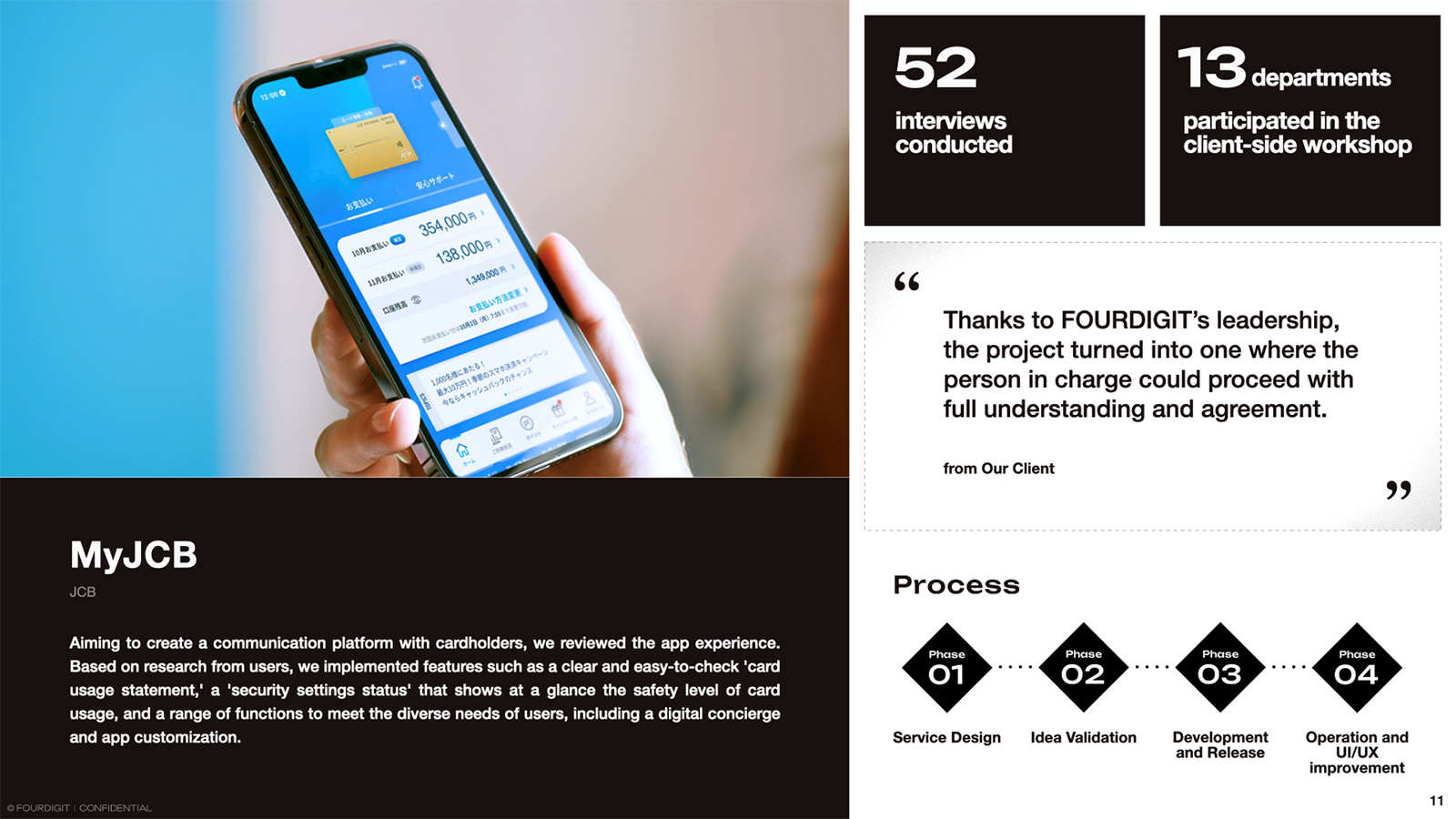
As an example of the FOURDIGIT approach, Mr. Taguchi introduced the 2023 redesign of MyJCB, an app for JCB card members. The project was a joint effort among JCB, service design lead FOURDIGIT and system development lead NTT DATA.
While JCB enjoys strong brand recognition, it had weak direct digital touchpoints with customers. “The project was not simply about updating a tool,” Mr. Taguchi explained. “It began with redefining the app as a platform for deeper customer communication.”
Because JCB services are used all over Japan and by customers of all ages, the team conducted interviews with over 50 users reflecting that spectrum, accompanied by a large-scale online survey. This enabled them to analyze generational differences and identify usage patterns — in what stores and for what purpose users open the app —across fine-grained segments.
The major insight that emerged was that users were, in fact, often unaware of all the app’s useful features. The redesign, therefore, focused not just on visual improvements but on making sure that the information was structured in order of priority and clearly communicated.
As a result of this UX-driven approach, MyJCB user engagement soared, with more users also actively utilizing previously languishing features. Mr. Taguchi noted that the app has also received international recognition for outstanding user experience quality, including at Germany’s iF DESIGN AWARD 2025 and Italy’s A’ Design Award & Competition.
MyJCB app redesign project
Strong cross-border collaboration potential
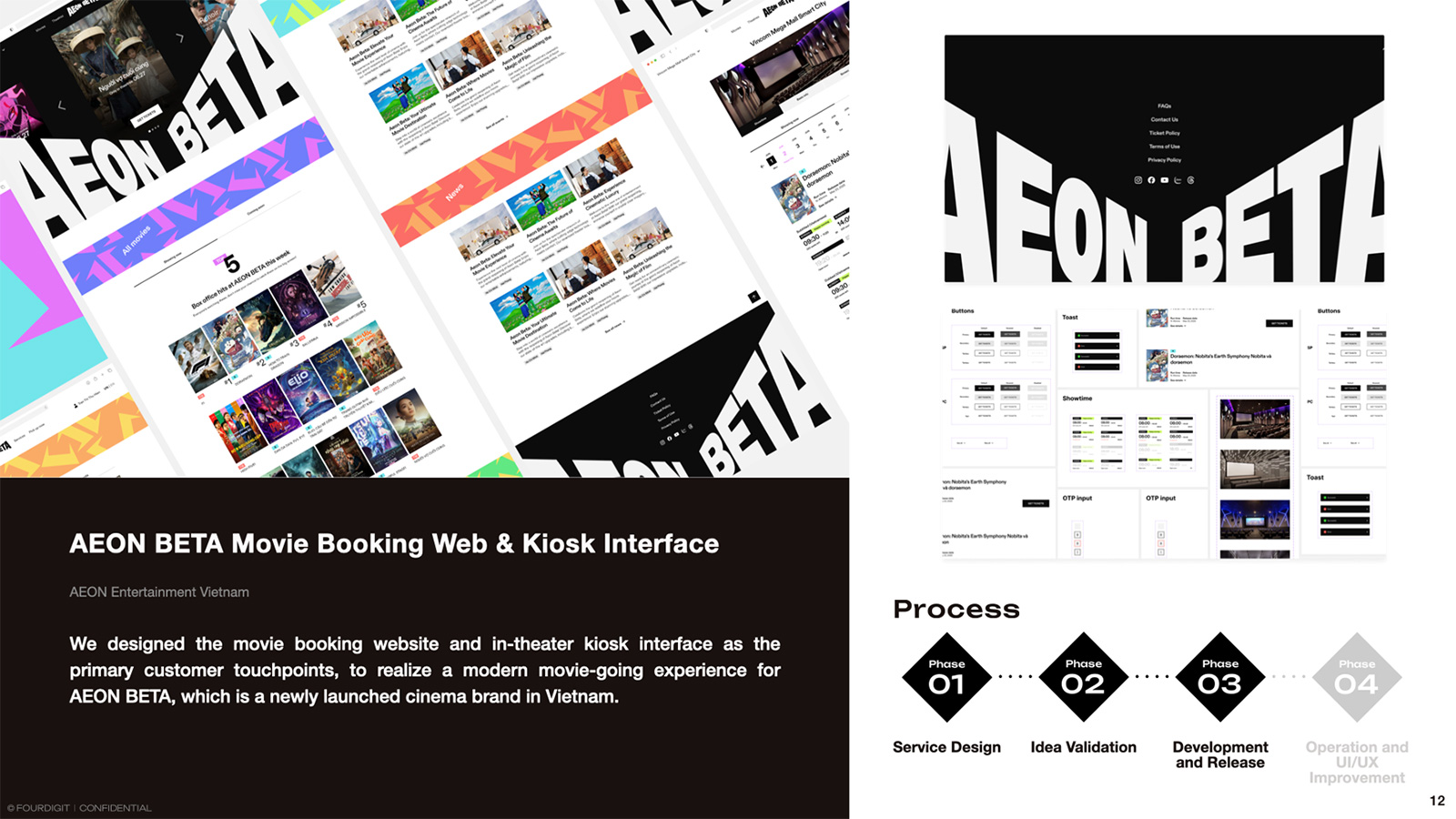
As an example of FOURDIGIT’s work in Vietnam, Mr. Taguchi highlighted a cinema launched by AEON Entertainment as part of its expansion into the Vietnamese market. “Located within an AEON Mall, the cinema was expected to generate mutual customer traffic with the mall.”
FOURDIGIT was in charge of designing the cinema kiosk interface and website. For the kiosk interface, it worked with system development lead NTT DATA and payment mechanism provider Payoo. “FOURDIGIT translated and integrated NTT DATA’s robust system and Payoo’s payment platform into a seamless user experience,” Mr. Taguchi explained.
The kiosks, used for purchasing tickets and other services, were designed to support both cash and cashless payments, but with a clear emphasis on cashless usage. “The goal was not only to enhance customer convenience, but also to reduce the operational workload for on-site staff.”
Following th cinema’s launch, the kiosk interfaces received great user feedback for its user-friendliness. According to Mr. Taguchi, designing the UI/UX for painless cashless payments has led to around 90% of transactions being conducted cashlessly while also slashing the operational burden.
AEON BETA cinema website and kiosk interface design
How did the kiosks achieve such a high rate of cashless payments? “For many projects in Japan, we have to adapt existing systems, but with this project, we were able to design and deploy the system from the ground up with cashless as the default,” Mr. Suenari said. “This allowed us to take a different approach — not changing the existing user experience but creating an optimal one from scratch.”
Mr. Suenari also highlighted differences in project approaches. “In Japan, projects often begin after carefully building a strong case for success. In Vietnam, there is a tendency to launch first and refine later. Both approaches have their strengths, but there are definitely things that Japan can learn from Vietnam — particularly in terms of speed to market.”

FOURDIGIT Inc.
Takehiro Suenari
Japan, on the other hand, has a strong culture around shopping reward points. “The Japanese like collecting and using points, but points-based systems haven’t really taken off yet in Vietnam or much of Southeast Asia, where immediate cashback is more popular.”
He noted that JCB is already running a digital cashback program in Vietnam, reflecting local market preferences. Looking ahead, though, FOURDIGIT believes that points-based systems are likely to gain traction in Vietnam too and plans to develop services aligned with that shift.
Mr. Suenari highlighted major potential for cross-border collaboration that puts Japan’s insights to work in the Vietnamese market — like points, for example. “At the same time, things like points are just features. What will become increasingly important is the emotional value that resonates with users beyond those features. FOURDIGIT aims to support the design of such experiences,” he concluded.