





Strengthening Cyber Resilience in the Indo-Pacific Requires Collaboration Throughout Society and the Regional Community
“Our society must recognize that cybersecurity is not a cost, but a vital investment in future growth,” asserted Minister for Digital Transformation Hisashi Matsumoto in his opening remarks. With Japan’s cybersecurity policy entering a new phase, he emphasized the need for both the public and private sectors to recognize their respective roles and responsibilities and align their perspective to confront cyber threats.
He added that “cyberspace is an international public asset that benefits many countries and stakeholders.” “In order to achieve a free, fair and secure cyberspace, we need to bring together cross-border experience and insight throughout the Indo-Pacific and foster meaningful cooperation.”
Yoichi Iida, who assumed the newly established position of National Cyber Director in July 2025, noted that while the Indo-Pacific, including Japan, is becoming a growth center for the digital economy, it is also increasingly becoming the target of malicious cyber activities. He added that enhanced cyber resilience in the region will also serve as a foundation for global stability and prosperity.
Cooperation and Information Sharing Founded on Mutual Trust Is an Urgent Priority
During the first half of the ensuing panel discussion, senior government officials from several countries discussed ways to enhance cyber resilience across the Indo-Pacific. Iida emphasized the importance of combining bilateral and multilateral cooperative frameworks in a flexible manner while respecting diversity, recognizing past experience and country-by-country differences in policy and other environments.
Sami Khoury, Senior Official for Cyber Security in the Government of Canada, stressed how important it is for governments to promote information sharing and build long-term public-private partnerships. Recognizing that companies are often reluctant to disclose security incidents, he explained, “We need to take time to build trust through face-to-face relationships, balancing information sharing with confidentiality.”
David Koh, Chief Executive of the Cyber Security Agency of Singapore, highlighted the need for governments to start by breaking down the silo mentality in their own organizations. He also stressed the need to raise awareness and promote basic cyber hygiene among small and medium-sized enterprises (SMEs) with limited resources.
During the Q&A session, where much discussion centered on government cooperation with Big Tech, Koh introduced an example in which the Singapore government and Google worked together to tackle Android sideloading issues. He noted that this initiative later expanded to Thailand and India. Iida pointed out that combining information held by governments with information held by the private sector is essential to counter cyber threats.
Moderator Nobushige Takamizawa, a senior fellow of the Sasakawa Peace Foundation, praised the initiatives undertaken by Japan, Canada and Singapore — three countries that have already built a relationship of mutual trust. He wrapped up the discussion by stating that trust-building through dialogue between nations will remain key going forward.
Everyone Has a Key Role in Frontline Defense: Support and Solutions for SMEs Remains a Key Challenge
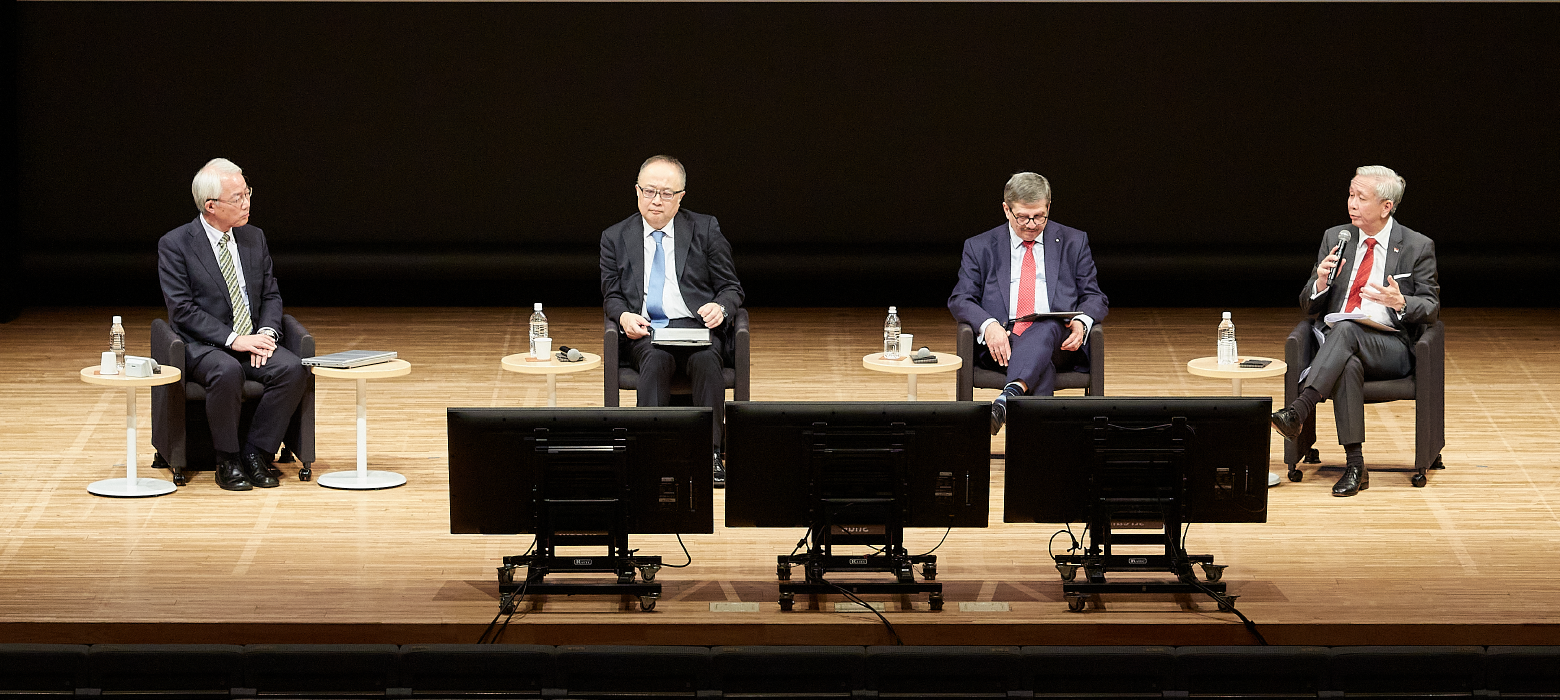
In the second half of the panel discussion, participants discussed the need for a public-private partnership in cybersecurity and how specific roles should be divided.
Teerawut Wittayakorn, Deputy Secretary-General of the National Cyber Security Agency of Thailand, advocated that a whole-of-society approach is essential for cybersecurity. He emphasized that all stakeholders must play a role in the front line of defense: governments by establishing national standards and developing information-sharing platforms; the private sector by strengthening their incident response capabilities and supply chains; academia through research, independent evaluation and talent development; and the general public by practicing sound cyber hygiene.
Discussion also focused on support for SMEs. Stan Singh-Jit, Chairman of the Asian-Oceanian Computing Industry Organization pointed out that SMEs face a triple challenge in that they lack awareness, knowledge and resources. Wittayakorn introduced specific measures implemented in Thailand, which has a large number of SMEs, including providing government financial support and establishing cybersecurity consultation hotlines.
Mihoko Matsubara, Chief Cybersecurity Strategist at NTT, Inc., noted that because media reporting tends to focus on incidents at major companies, SMEs mistakenly believe that they will not be targeted. She stressed the importance of sharing security solutions that can be implemented even without in-house experts.
Related Link
National Cybersecurity Office
- Information Development SimSpace Cyber Range Enables Practical, Real-World Defensive Exercises
- Kyndryl Cyber Resilience Strategy in an Age of Complex, Systemic, and Interconnected Risks
- Google Google’s Observations: State-Sponsored Cyberattacks and Cybercrime Targeting Japan Are Intensifying
- ServiceNow Japan With Shadow AI Expanding Attack Targets, “AI Registries” Provide Visualization and Governance Capabilities
- Sophos A Binary Choice Between Data Recovery or Payment? How Should We Combat Ransomware?
- Tanium Avoiding Invisible Risks Through Real-Time Visualization and Robust Controls
- Rubrik Japan Recoverability and Cyber BCPs Are Essential in an Era of Unavoidable Threats
-


