



As corporate financing methods and the asset management needs of investors continue to diversify, how will the most attractive funding options for Asian companies change? We spoke with Toru Yoshida, President of Rating and Investment Information, Inc. (R&I), Japan’s leading credit rating agency, to hear his perspective.
“Diversifying funding sources will become more important than ever”
—The global surge in AI and semiconductor-related industries is driving stock markets. Japan’s benchmark stock index, the Nikkei 225, and the US Dow Jones Industrial Average were both trading near record highs at the time of this interview in late May. Meanwhile, institutional investor activity in the Japanese market has remained robust, with the average daily trading value on the Tokyo Stock Exchange Prime Market exceeding 10 trillion yen. Where will this growing pool of investment and financing capital flow from now on?
“Although robust trading activity, which has drawn in private investors, has been continuing despite ongoing geopolitical risks, the global political and economic landscape has grown increasingly complex and uncertain. Amid such circumstances, the relative stability of the Japanese economy seems to once again be drawing attention. The US-China tensions and instability in the Middle East are generating demand for new investments in areas such as infrastructure and resource development as companies are seeking to diversify their supply chains.”
“Against this backdrop, investors are looking for new investment opportunities that offer stable growth in the medium- to long-term perspective. As they continue to diversify their portfolios as a measure to disperse risk, Japan along with the broader Asian market, which is demonstrating strong growth potential, is taking on greater importance. Asian companies may also be approaching a turning point in how they raise capital. Diversifying funding sources will become more important than ever.”
—Does this mean that, in the current business environment, Asian companies should also look to Japan as a source of funding?
“Indeed they should. The Japanese government continues to promote Japan as a leading asset management center. Coupled with steady progress in corporate reforms—including the strengthening of the Corporate Governance Code—this has inspired interest among private investors in stocks and investment trusts. The fundamentals of the Japanese economy remain strong, and institutional investors are demonstrating a high motivation to invest. We are increasingly hearing from investors who are interested not only in investing within Japan but also in other areas throughout Asia with high growth potential. Asian companies should give greater consideration to Japanese markets and financial institutions as stable and reliable sources of funding.”
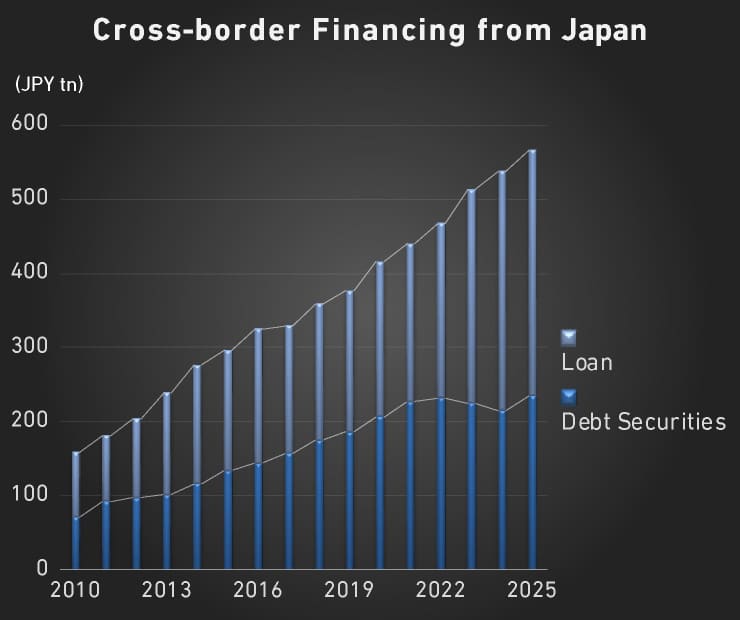
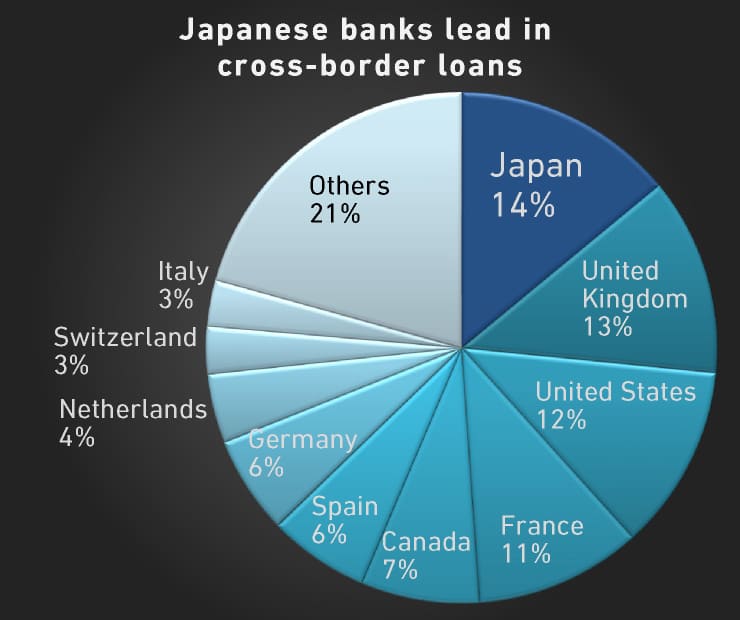
“According to the Bank of Japan’s Flow of Funds Statistics as of the end of 2025, Japanese household financial assets reached a record 2,351 trillion yen. Outstanding loans from Japan to overseas and outstanding bond investments also climbed to all-time highs of 332 trillion yen and 235 trillion yen, respectively. Of particular note, according to BIS statistics, Japanese banks are the world’s largest cross-border lenders. As a rating agency, we play a role in facilitating the flow of information between Japan and the countries and regions where future financing needs are expected to grow, to aid in fostering greater mutual understanding.”
Source: Bank of Japan "Flow of Funds Statistics, 2025 Q4"
Source: Bank for International Settlements "Consolidated banking statistics, 2025 Q4"
—What is necessary for Japanese investors to take a greater interest in Asian companies?
“One of the biggest barriers is information asymmetry; in other words, Japanese investors are not well informed about Asian companies. This is where ratings issued by independent third-party agencies play an important role in bridging the gap, by providing an objective assessment of a foreign company’s creditworthiness. From the investors’ perspective, ratings that allow for a consistent comparison between overseas and Japanese issuers make investment and financing decisions much easier.”
“It’s not only when investors purchase yen-denominated foreign bonds (Samurai bonds) issued by well established foreign issuers. Ratings also play a vital role when Japanese financial institutions evaluate whether to extend loans to companies in various parts of Asia, or when institutional investors consider participating in syndicated loans to companies or projects across Asia. Having a credit rating also makes financing easier because our ratings may enable Japanese banks to save their risk-weighted capital in accordance with Basel regulations. It is clear that a credit rating is essential for any company wishing to appear more attractive to investment and financing institutions.”
Credit Ratings: A bridge to growth
—To ensure financing from Japan, choosing the right credit rating agency is also an important consideration.
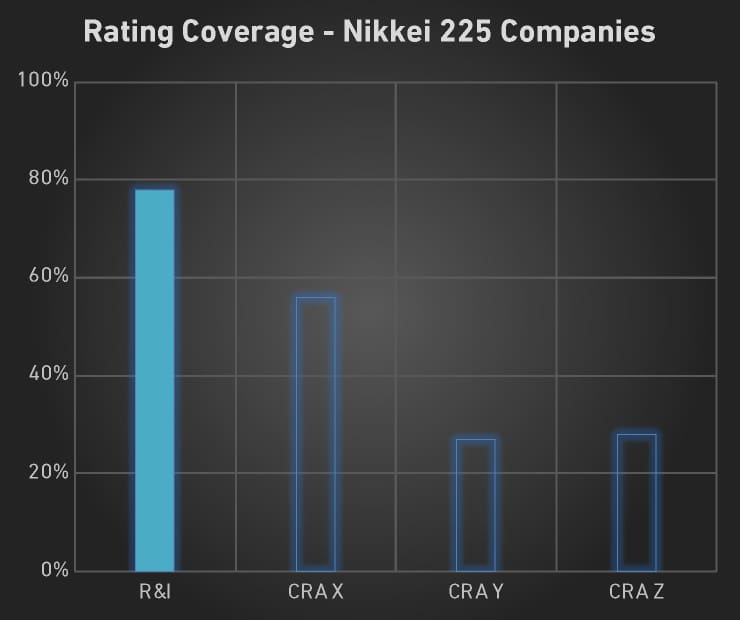
“R&I is one of Japan’s leading credit rating agencies with more than 50 years of experience in the ratings business. Our ratings are widely trusted by investors as an important benchmark when making investment and financing decisions. Today, 86% of Japan’s domestic corporate bond market is covered by R&I ratings, and we provide ratings for more than 800 issuers.”
As of December 31, 2025
Source: Nikkei, R&I, Credit Rating Agencies registered in Japan
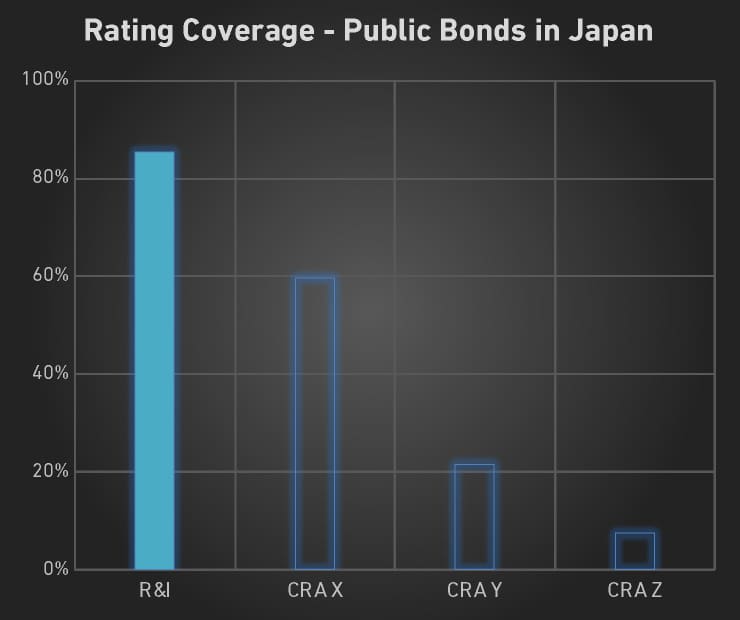
For the full year 2025
Source: Japan Securities Dealers Association, R&I
“Our ratings are so trusted because we are one of the industry’s largest analytical organizations with a team of more than 80 in-house analysts. Our analysts possess expertise in a wide range of fields, including accounting standards, real estate transactions, and aviation finance. They gather accurate information on the companies we cover in order to evaluate and analyze various factors that influence corporate management. They then forecast changes in earnings and financial structure, and deliver a comprehensive assessment of the company’s creditworthiness.”
“Through this rigorous analytical process and our deep understanding of the market, we have maintained consistent and stable default rates for every rating level. Our cumulative default rates are comparable to those of leading international credit rating agencies such as Moody’s and S&P. Our rating performance has remained highly stable. Since 2016, the annual default rate among issuers rated by R&I at the beginning of each year has been 0%.”
“R&I’s reliability is reflected in the spreads (funding costs) that issuers can achieve when issuing bonds in the Japanese market. Bonds with R&I ratings tend to be issued at lower spreads than those with the same rating from the other Japanese credit rating agency. R&I ratings serve as a key benchmark for institutional investors when investing in corporate bonds. For overseas issuers, being assessed on the same basis as Japanese issuers boosts their reputation as favorable, attractive investment opportunities.”
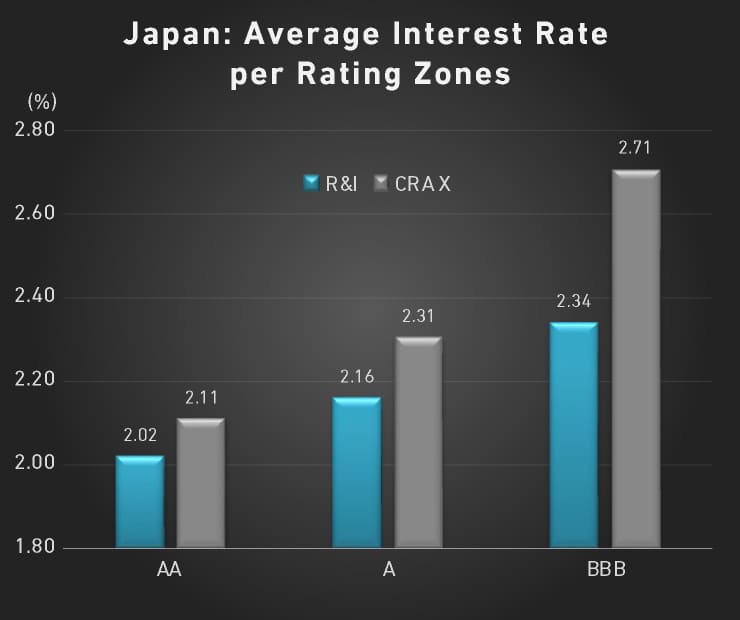
3-Year Bonds, Average of May 2026
Source: Japan Securities Dealers Association
—As financing and operating needs continue to diversify, R&I has been quick to offer ratings for emerging categories such as securitized products and financial derivatives.
“We are frequently approached by financial institutions and other organizations seeking ratings for newly structured financial products, and we have thus been actively providing ratings in these new domains. Over the years, we have developed expertise in evaluating a wide range of finance objectives, including project finance, business unit ratings, and assessments of green bonds for compliance with international standards.”

—For companies expanding globally, what is the significance of building stronger ties with Japan?
“We believe that Asia, with its large population and robust industrial base, is poised for significant future growth. The key to unlocking this growth lies in circulating capital between Japan and the rest of Asia. R&I’s ratings are widely recognized internationally and can serve as a passport to global business. We recognize that developing capital markets in a manner that ensures long-term soundness is of paramount importance, and we are committed to bridging the gap to growth in markets throughout Asia by providing evaluations of corporate credit—the foundation of that soundness.
“If Asia as a whole prospers, then Japan will prosper as well. We hope that our ratings will serve as a cornerstone for deeper mutual understanding between Japan and other parts of Asia within the financial sector.”