Head of Automotive Div.
NTT DATA Japan Corp.
PARTNER CONTENT
NTT DATA
Software-Defined Vehicles
Redefining mobility: The software-defined vehicle
We are all familiar with the acronym EV—but what exactly is an SDV? Standing for software-defined vehicle, an SDV is the next-generation of automobile: a securely connected, AI- and data-driven car. And everything about SDVs is different. Jettisoning the old model of hardware-centric design, they are designed from the get-go with a focus on services and user experience and their capabilities can be enhanced throughout their life span.
This idea is neatly captured in the “ever-evolving software-defined vehicle,” the first of three perspectives that systems integrator NTT DATA applies when thinking about the SDV revolution. These days, the release of a new car no longer means the car is finished; instead, the launch is the starting point for a never-ending evolution, as over-the-air updates tailor the car to the usage patterns and lifestyle of the individual driver, while digital twins enable real-time testing of the next-generation of vehicle software.
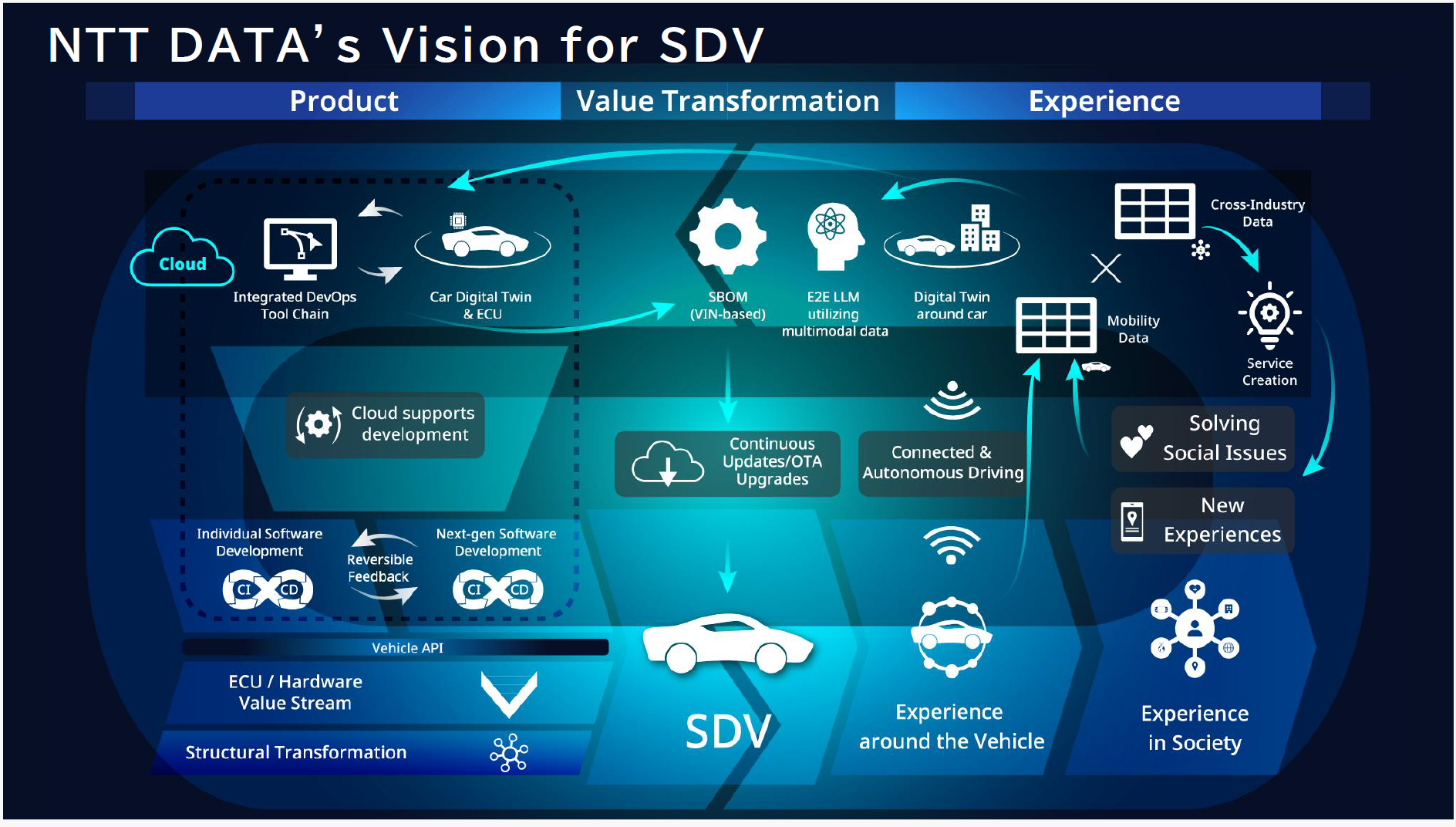
One positive upshot of this ever-evolving state is “safe and secure mobility.” NTT DATA is currently working with a large Japanese OEM on a proof of concept where car sensors and infrastructure sensors talk to one another at urban crossroads. AI uses this data to perform real-time analysis to envision potential accident scenarios before issuing warnings using real-time connectivity. The result? Blind spots are eliminated, and collisions avoided.
The automotive industry has long been moving in a more ecofriendly direction, and “sustainable urban life” is the last of NTT DATA’s three perspectives. Initiatives here include developing a battery traceability platform to support the dismantling, reuse and recycling of old EV batteries. Another interesting proof of concept involved monitoring driver’s reaction times to measure cognitive performance in areas such as memory, attention and execution. “At NTT DATA, we add new functions to harmonize vehicles, people and cities in a sustainable way,” says Gustavo Filip of NTT DATA Deutschland.
In the SDV era, automakers are competing on their ability to operationalize AI at scale as much as on hardware innovation. Embedding intelligence securely and responsibly across the vehicle lifecycle requires enterprise-grade AI architecture and governance. This is where NTT DATA positions itself as a long-term transformation partner.
A new automotive industry ecosystem is taking shape
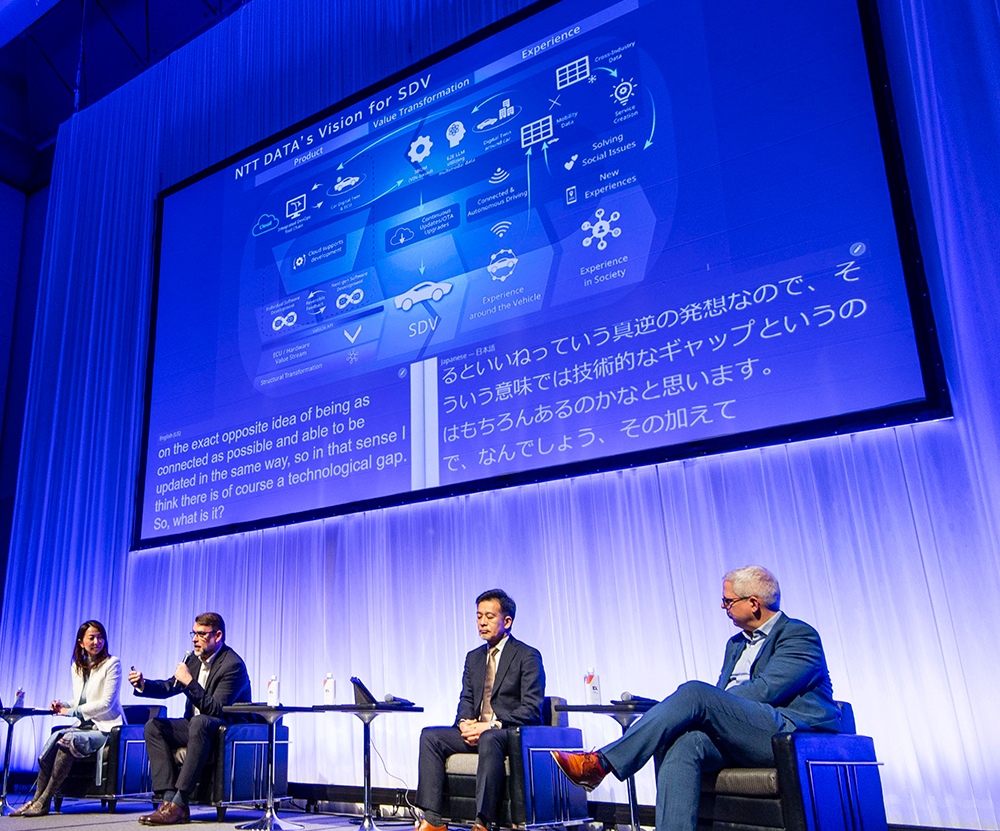
At a special event at the Automotive World exhibition in Tokyo on January 23, 2026, NTT DATA brought together key players from the global auto industry to discuss how software-defined vehicles (SDVs) are going to change all our lives, and the challenges facing the industry as it switches to new business models.
These are complex, volatile and uncertain times. One thing, though, is certain: customers’ needs are always evolving. Since software is all about flexibility and updating things later down the line, the software-defined vehicle can meet those needs, adapting itself through an endless feedback loop linking the physical world of the car and the digital world of software, argued Mamiko Nunoi of NTT DATA. In addition, cars are now part of a broader ecosystem, connected to the urban environment, companies and consumers. “From standalone products cars have become ‘data nodes’ and utilizing this data is a way to create new value,” Nunoi said.
Honda is putting these sorts of technologies into action with the Honda 0 saloon. Pronounced zero, the name refers to redefining mobility from zero, while aiming for zero pollution and accidents. Among other safety-related innovations, Honda envisions a car that can detect approaching cyclists and pedestrians via their smartphones to alert them to the car’s presence so they can take appropriate precautions. At Honda, AI will play a crucial role in developing next-generation automated driving and advanced driver assistance systems (AD/ADAS), expanding the conditions in which such systems can be used, and it is also expected to revolutionize how vehicles are developed. “AI will soon take a leading role in development,” said Honda’s Kunimichi Hatano. “With digital twins and digital proving grounds, things that used to take 10 to 20 years will only take three to five. We can’t even imagine what AI will be capable of in 2030.”
Mamiko Nunoi
Marcel Bodensiek
Director,
Digitalization and Organization,
FAW-Volkswagen
Digitalization and Organization,
FAW-Volkswagen
Kunimichi Hatano
Executive Chief Engineer, Automobile Operations,
SDV Business Development Unit,
Advanced Safety & Intelligent Solution Development Div.
Honda Motor Co., Ltd.
SDV Business Development Unit,
Advanced Safety & Intelligent Solution Development Div.
Honda Motor Co., Ltd.
Prof. Dirk Slama
Vice President,
Robert Bosch GmbH
Robert Bosch GmbH
Since 1991, FAW-Volkswagen, the Chinese joint venture of Volkswagen, has sold a cumulative 30 million vehicles. But as a legacy car maker, competing with new Chinese entrants working off a clean slate is not proving easy. Customer focus has shifted from engineering and quality—areas where Volkswagen excels—to functionality and consumer interaction. “Developing new cars used to take us 48 to 54 months. Now we need to produce them in 18 to 24 months. How do you do that?” asked FAW-Volkswagen’s Marcel Bodensiek. The secret is to focus on an extended V-model in the software development process, covering functional development, realization, and testing, and constantly add new functionality to the car through other-the-air (OTA) updates.
Bosch’s Dirk Slama drew a critical comparison between the industry’s traditional five-year planning models and more adaptive, fast-moving organizational structures. While incumbent manufacturers used to take years to make cars which they then didn’t update for several years more, while Chinese companies are creating not just next-generation car architecture but entire organizations from scratch. “Their organizations have a different DNA,” Slama said. “A truly successful company needs a DNA that can cope with multiple speeds.” To realize this, the digital.auto initiative led by Dirk Slama has developed an agile, multi-speed version of the traditional V-model, with digital operating in hours, electrics and electronics (E/E) in weeks, and the mechanical aspects of the vehicle—where safety is paramount—operating in months. He envisions a future where AI agents handling requirements, developments and testing for the OEMs will “play ping pong with one another,” unencumbered by legacy tool chains.
As the auto industry goes through a once-in-a-century transformation and grapples with AI-driven disruption, balancing the technological, political and societal aspects of the change is key. “NTT DATA is contributing to the integration of this multiplayer ecosystem,” said NTT DATA’s Nunoi. “By combining automakers’ engineering expertise with software capabilities, we can help build a better society.”
Enabling AI-native automotive transformation at global scale
In 2025, NTT DATA’s Automotive Division generated worldwide sales of over US$1.6 billion. Vice President of Global Automotive Gustavo Filip explains how the company is positioning itself as a long-term transformation partner for AI-native mobility markets, helping automakers go from experimentation to execution.
The world’s third-largest data center provider and eighth-largest IT services market vendor, NTT DATA is a genuinely global, full-stack company. On the automotive industry side, the company designs, develops, operates and integrates applications for its customers, as well as providing consultation services.
It is crucial for NTT DATA to have a footprint in China as the country emerges as one of the most dynamic and fast-moving markets in EV and SDV development. The company currently has around 4,500 employees in 14 Chinese cities, of whom around 2,000 work for its automotive division. “Today, we don’t need to bring know-how from the West into China. In fact, it’s the opposite. In SDVs, we are drawing insights from leading SDV ecosystems and sharing best practices across our global network,” says Vice President of Automotive Gustavo Filip.
NTT DATA is also creating a center of excellence focused on the connected car in India, home to almost one-fifth of the company’s workforce. The center is distributed across two locations: Bengaluru, the center of the Indian IT industry, and Chennai, the center of the Indian automotive industry.

More than three-quarters of NTT DATA’s nearly 200,000 employees are now based overseas. Even so, Japanese values such as long-term partnerships, trust, quality and reliability remain central. “That’s the spirit of the company and it’s something that customers appreciate,” says Filip, pointing to NTT DATA’s multi-decade partnerships with Japanese and German OEMs, as well as with Japanese companies outside Japan.
The testimony of such customers is crucial when it comes to promoting the company around the world. “We talk to the media, work with analysts, and participate in major industry events, but the most important thing is always our customer stories. That’s the way we want to be credited. We are a sort of hidden champion,” Filip says.
“Responsible innovation” is a key part of NTT DATA’s philosophy. In an AI-native automotive future, responsible innovation means embedding governance, scalability, and measurable impact into every layer of the transformation. “Although our customers do lots of proofs of concept, they often struggle to adopt AI in a way that delivers positive economic impact,” Filip explains. “We co-create AI solutions with them that work in a real-world context. We’ve turned thousands of pilots into production-grade intelligence embedded into live ecosystems. We handle the last mile.”