PARTNER CONTENT
Japan Securities Summit

The 15th Japan Securities Summit 2026 in London

With record-setting equity markets and a revitalized bond market,
Japan is now a strong investment alternative in an age of uncertainty

The 2026 Japan Securities Summit was held in the Mansion House, the residence of the Lady Mayor, in the heart of the City of London, on February 11, 2026. Government ministers, finance officials, central bankers, exchange operators, market professionals and academics gathered to discuss the outperformance of Japan’s equity markets, the generational reset in its bond market and the fiscal implications of Prime Minister Sanae Takaichi’s recent landslide election win.

1 OPENING REMARKS

Resilience and clarity in an uncertain environment

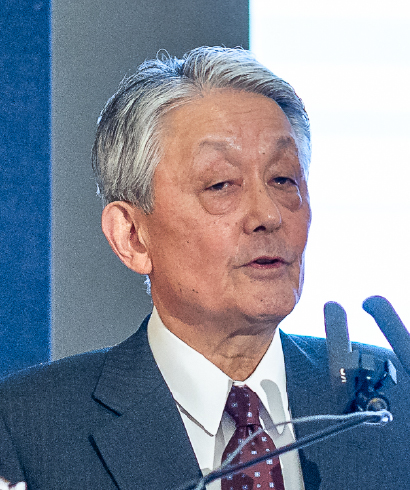
Mr. Bryan PASCOE
Mr. Bryan PASCOE,
Chief Executive, International Capital Market Association (ICMA)

The timing of this forum could not be better. Japanese equity markets continue to soar to all-time highs, while interest rate normalization is bringing Japan back into the mainstream of international bond market activity. The recent election result has set the scene for further expansion of JGB issuance and fiscal expansion. Changes in the relative attractiveness of markets are driving flows toward Japan. Amid macro uncertainty and elevated geopolitical risks, investors are seeking resilience and clarity. In that context, Japan’s markets have a distinct role. Japan has taken important steps to improve its competitiveness by strengthening its position as an asset management hub and fostering conditions that allow capital to be deployed at scale with the appropriate incentives, transparency and stewardship.

An increasingly attractive destination for global capital

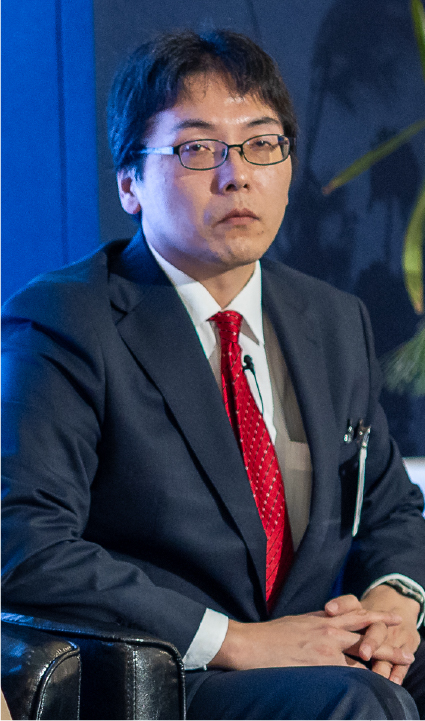
Mr. Takashi HIBINO
Mr. Takashi HIBINO,
Chairman and CEO, Japan Securities Dealers Association (JSDA)
[delivered by Motonobu MATSUO (Vice Chairman/Senior Managing Director)]

The Japan Securities Summit has been a platform for dialogue between Japan and the global investment community since 2008. In recent years, Japan has witnessed not just a cyclical recovery, but meaningful structural transformation. Japanese companies are increasingly focusing on improving capital efficiency and corporate value, while domestic investors are steadily shifting from savings to investment. The Japanese market is becoming a more disciplined and investor-oriented environment, developments which have contributed to solid equity market performance and made Japan an increasingly attractive destination for global capital. Going forward, I expect that efforts to strengthen the foundation of Japan’s economy and financial system and support sustainable growth will continue. I am confident that today’s summit will provide valuable insights and foster a deeper understanding of Japan’s securities market.

2 WELCOMING REMARKS

Steadfast friends in a rapidly changing world

Alderwoman Dame Susan LANGLEY
Alderwoman Dame Susan LANGLEY,
Rt. Hon. the Lady Mayor

These are challenging times. Geopolitical tensions must not be allowed to undermine the values of free trade, which both Japan and the United Kingdom champion. Other countries may turn inward, but Japan and the United Kingdom continuously look outward, and our relationships are all the stronger for it. Japan’s asset management industry is at an inflection point and there are significant opportunities for knowledge exchange between our two countries, and for U.K. asset managers seeking expansion. The United Kingdom has the world’s second-largest asset management market. There is much we can do together as business partners and as steadfast friends.

3 GUEST SPEECH (Video message)

Finance will accelerate Japan’s economic growth

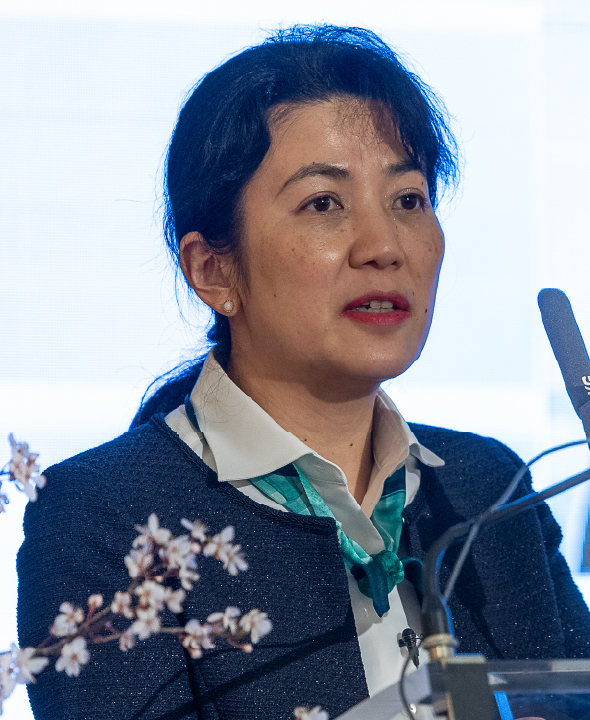
Ms. Satsuki KATAYAMA
Ms. Satsuki KATAYAMA,
Minister of Finance and Minister of State for Financial Services

Japan is shifting from a deflationary, cost-cutting economy to a dynamic growth-oriented one. Finance is essential to sustaining this positive momentum. The government is promoting Japan as a leading asset management center. For Japanese households, the number of NISA accounts has increased across all age groups. For companies, corporate governance reform has made significant progress. In summer 2026, the government will develop a comprehensive financial services strategy, while a plan was formulated last year to ensure Japan’s regional financial institutions play a greater role in supporting local economies. Innovative digital payment services are another important issue to consider. We are working to enhance the value of Japanese companies through finance, foster an economy trusted by global investors and create a virtuous cycle in which capital flows into Japan.

4 KEYNOTE SPEECH

Tokyo: Well-positioned in a shifting global landscape

FinCity.Tokyo’s power resides in expertise and an extensive network of financial institutions. The aim is to promote innovation in financial services and advance policies that address social challenges.

During the bubble years, complacency, vanity and a nouveau riche culture prevailed. Japan, however, has learned its lesson. Its economy is now well on the way to growth, with corporate profits and wages rising, and deflation conquered. With the United States stepping down as the standard-bearer of free trade, Japan has seen record high capital inflows. As global investors diversify away from the U.S. dollar, financial centers like Tokyo and London, built on democracy and the rule of law, are well positioned to grasp opportunities.

Two possible areas for future collaboration between London and Tokyo that FinCity.Tokyo supports are an emerging managers program (EMP) for independent asset managers, and transition finance. FinCity.Tokyo wants to play a part in Japan’s efforts to contribute to maintaining global economic and financial stability.

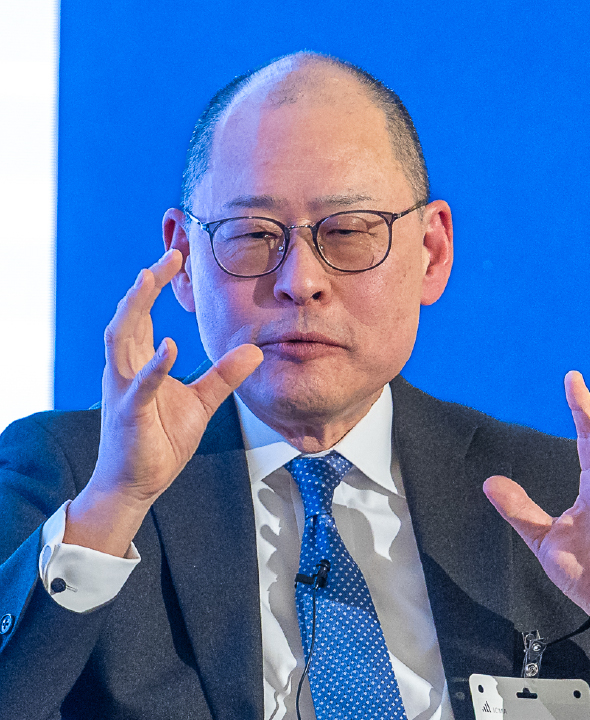
Mr. Hiroshi NAKASO
Mr. Hiroshi NAKASO,
Chairman, FinCity.Tokyo
5 LEAD SPEECH 1

Tangible results and next steps in the reform programme

Mr. Toshiyuki MIYOSHI
Mr. Toshiyuki MIYOSHI,
Vice Minister for International Affairs, Financial Services Agency, Government of Japan

The Takaichi government plans to expand the existing initiative to promote Japan as a leading asset management center. An overview of recent progress and next steps follows.

After a 2024 revision, one in four Japanese adults now holds a NISA account, and a tax amendment plan for the next fiscal year proposes opening up NISA accounts to children under 18. The FSA also plans to revise the corporate governance code, which has already changed the corporate mindset since its 2015 introduction. The revisions will encourage companies to focus on enhancing their corporate value, examine resource allocation and publish their annual financial reports before AGMs. Despite all this, the number of asset management firms operating in Japan remains low compared with overseas markets. To address this, the FSA has set up an emerging managers promotion (EMP) program and has made regulatory amendments in order to lower barriers to entry.

Going forward, the FSA will continue working to strengthen corporate governance and the asset management industry so that financial assets can be channeled into productive investment and households can reap the benefits.

6 PANEL DISCUSSION 1

Japan’s Economic Outlook and Investment Opportunities:
Why Japan?

photo
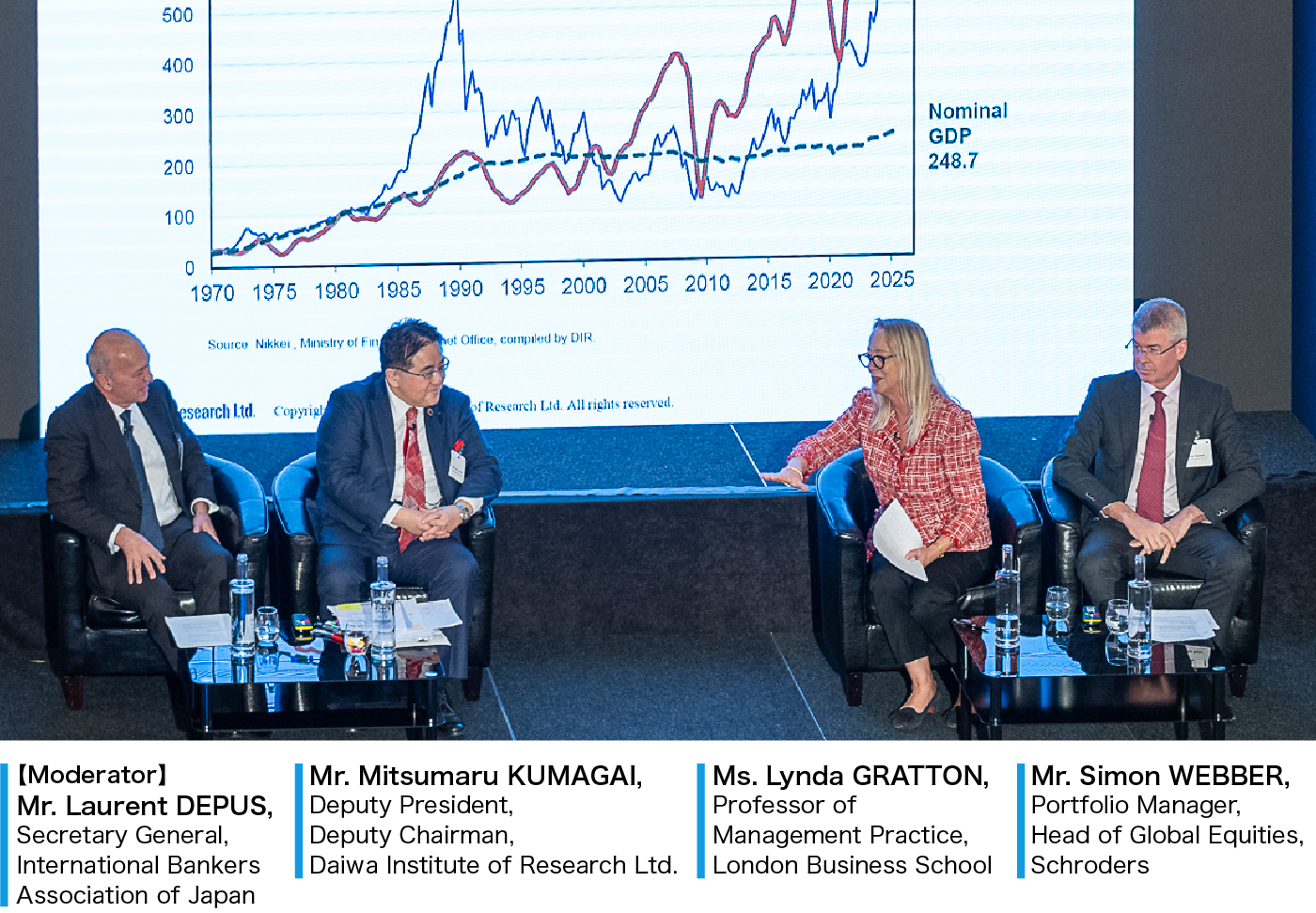
【Moderator】Mr. Laurent DEPUS,
Secretary General, International Bankers Association of Japan
Mr. Mitsumaru KUMAGAI,
Deputy President,
Deputy Chairman,
Daiwa Institute of Research Ltd.
Ms. Lynda GRATTON,
Professor of
Management Practice, London Business School
Mr. Simon WEBBER,
Portfolio Manager,
Head of Global Equities, Schroders
photo

This panel examined three things: the current situation of the Japanese economy, risks and, finally, opportunities.

For Kumagai, the Japanese economy is at a historical turning point. Structural changes are accelerating as the economy emerges from deflation, wage hikes gather momentum and capital investment increases. Supporting factors include improvements in the household income environment, government economic policy and continuing accommodative monetary policy. Kumagai sees Japanese stocks as undervalued relative to corporate profits.

Although mindful of the highly cyclical nature of the Japanese economy, Webber described Japan as an “incredibly vibrant and exciting market” with key technologies and some very good companies, providing a way to diversify away from U.S. equities. Particularly positive developments were the material increase in the number of companies buying back shares and the decline in companies trading at below book value.

What about downside risks? Kumagai reeled off five: The Trump tariffs; the deteriorating Japan-China relationship; escalating tensions in the Middle East and Ukraine; a sharp drop in the yen exchange rate; and rising domestic interest rates. For now, Prime Minister Takaichi is maintaining fiscal discipline, but that could change. “In the future, the administration’s expansionary fiscal policy might carry the risk of a yen depreciation cycle and a rise in long-term interest rates,” Kumagai commented.

Webber was worried about Japanese companies’ possible complacency in the face of the competitive threat from China, “an emerging giant and incredibly strategic in its investment, whether electric vehicles, the battery supply chain, or healthcare and pharmaceuticals.” On the market side, vulnerabilities he highlighted were the steepening of the yield curve, volatility in JGBs and the risk of rapid yen strengthening.

As the author of the influential book The 100-Year Life, Gratton’s focus was on demography. As Japan’s population ages and shrinks, the traditional three-stage life of full-time education, full-time work and full-time retirement is breaking down and needs to be replaced by the multi-stage life, with lifelong education, greater flexibility at work and a later retirement age. While Japan is doing exceptionally well on the healthy aging front, some Japanese organizations are proving too hierarchical and bureaucratic to embrace more flexible and amenable working conditions. Immigration, meanwhile, is needed to fill the skills gap. Is there any viable solution to population decline itself? Gratton pointed out that while some governments have managed to restrict the number of children women can have, none have ever succeeded in getting them to have more.

What, finally, about opportunities? If Japan can increase three key factors — labor input, capital stock and total factor productivity (TFP) — Kumagai believes that it could achieve a high-growth scenario, with annual economic growth of 1.5% through to 2040. For his part, Webber saw an opportunity in Japan’s best businesses ditching the bad habit of hoarding cash and achieving better capital efficiency. He also noted that the conventional view that a weak currency is good for Japanese stocks is out of date and that the combination of a strong stock market with a strong yen would be a major plus for foreign investors. The positives that Gratton singled out included soft power and social cohesion. “When you see what the lack of social cohesion does to a society, does to its economy, you realize this is a very important intangible asset,” she said.

7 LEAD SPEECH 2

Corporate governance reform is an ongoing effort

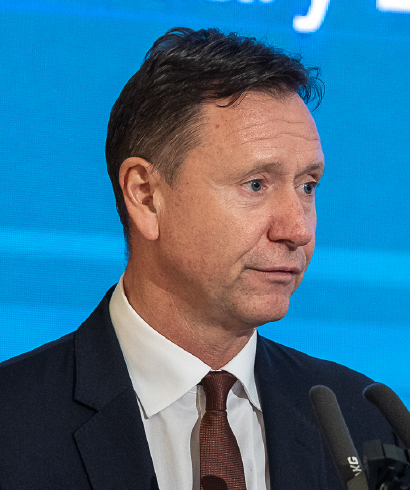
With various elements aligning to create strong momentum, both the TOPIX and the Nikkei 225 outperformed the U.S. market in 2025. Japan’s emergence from decades of deflation is one of the biggest factors behind this, while Japanese companies’ business performance is also very strong. Market transformation is the second factor. Domestic institutional investors are pushing companies to improve ROE, reduce cross-shareholdings, and increase board diversity. Japanese households are shifting their savings to investment through the new NISA, representing a growing segment in the market.

These structural changes are attracting more global investors to the Japanese market, just as the investors’ move to diversify away from the U.S.-centric portfolio gathers pace. Furthermore, the progress of corporate governance reform has contributed to investor confidence. TSE has been promoting governance efforts for more than two decades. With clear signs of changes in the governance structure, the reform is now at the stage to improve the quality of the efforts and better dialogue between management and investors. In 2023, TSE requested listed companies to be conscious of cost of capital and share price. More than 90% of the Prime listed companies have responded. The goal is to promote the sustainable growth and mid-to-long-term corporate value improvement. JPX is committed to continuing the reform and taking necessary action. This is only the beginning.

Mr. Hiromi YAMAJI
Mr. Hiromi YAMAJI,
Director & Representative Executive Officer,
Group CEO,
Japan Exchange Group, Inc.
8 PANEL DISCUSSION 2

Recent developments in the Japanese cash equity market:
What they mean for investors

Ms. Ayla WAGATSUMA
【Moderator】 Ms. Ayla WAGATSUMA,
Senior Manager,
Corporate Communications,
Japan Exchange Group, Inc.
Ms. Jen SISSON
Ms. Jen SISSON,
Chief Executive Officer, International Corporate Governance Network
Mr. Tomochika KITAOKA
Mr. Tomochika KITAOKA,
Chief Equity Strategist,
Nomura Securities Co., Ltd.
photo

Three factors — inflation, a decrease of equity outstanding and greater focus on profits — make a bullish case for Japan’s EPS outlook. “The Nikkei has already achieved our ¥56,000 target for this year-end and is closing in on our next year-end target,” Kitaoka said. Sisson was equally positive on Japan’s policy environment, describing it as “one of the most unified ‘Let’s do good governance as a driver for growth’ frameworks anywhere,” and praising the “phenomenal” progress of the last 10 years. She did, however, recommend a degree of scepticism. International investors may have been thrilled with the announcement about Japanese companies needing to publish their securities report before their AGM — but that is just standard procedure everywhere else. Progress on independent directors is undoubtedly being made — but a ratio of one-third is not that impressive compared to other major developed markets. There is a bifurcation between big global companies which embrace best practices and the many listed companies still somewhat reluctant to change.

Japanese non-financial corporations still have about ¥100 trillion, or over 10% of total assets, in cash and deposits. This practice speaks of a lingering deflationary mindset and is “destroying corporate value in real time,” according to Kitaoka, who pointed out that the equivalent percentages in Europe and the United States are around 8% and 6%, respectively. Holding such levels of cash is neither internationally competitive nor compatible with maximizing long-term sustainable value for companies and shareholders, noted Sisson, adding that too many Japanese companies were prone to reflexively resist engagement with investors.

Activist or engagement funds own over 1.1% of Japan equities. Recently, they have broadened their targets from cash-rich companies to property-rich companies and listed affiliates. Given that the equivalent ratio in the United Kingdom is above 2%, Kitaoka expects the upside momentum of this activist presence to continue.

The panelists concluded by stressing the bullish outlook, that this room for improvement suggests great opportunity for investors, with Sisson pointing to the “enormous hope” she gets from the Japanese policy environment, while Kitaoka highlighted the timely combination of the inflationary shift, labor shortage and the TSE and FSA’s corporate engagement.

9 FIRESIDE CHAT

Insights into the JGB market - primary and secondary - Initiatives at the Ministry of Finance

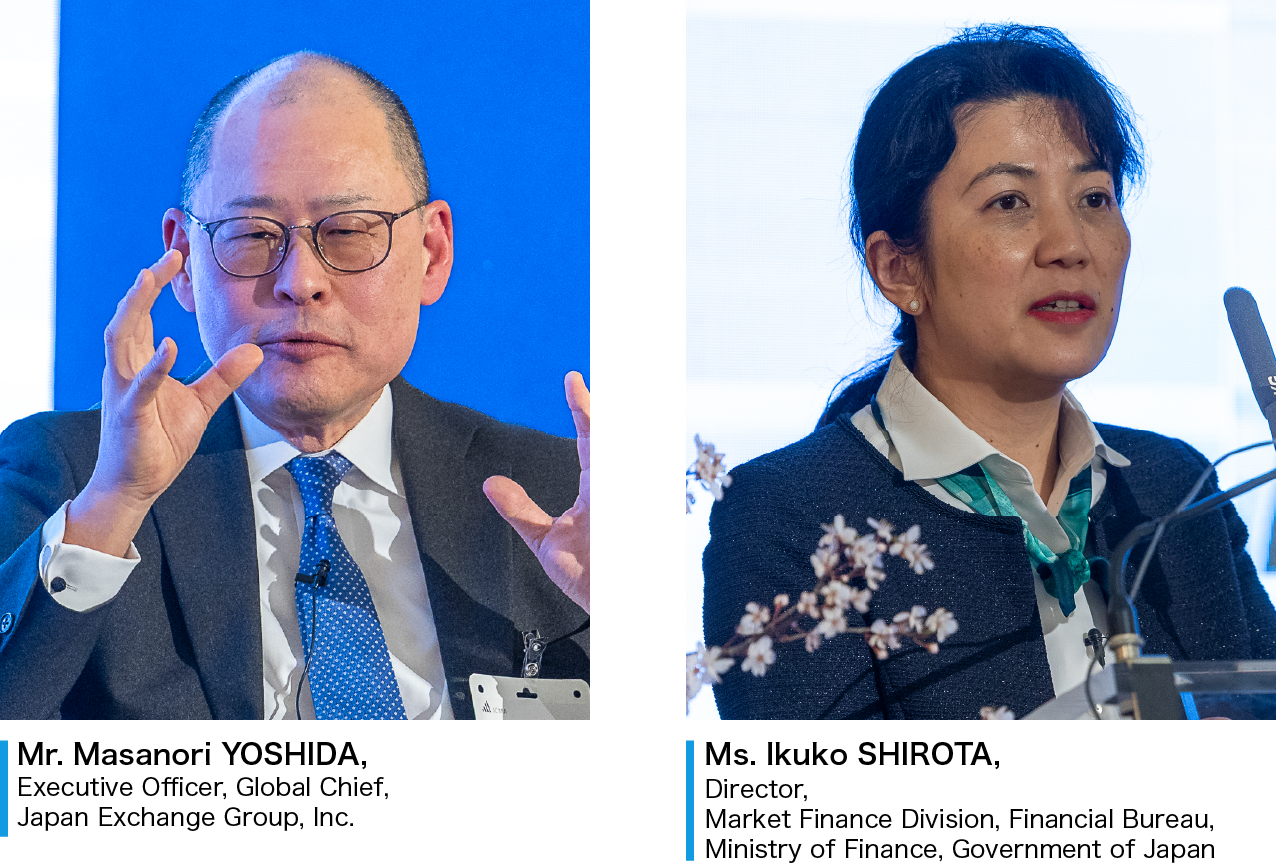
Mr. Masanori YOSHIDA
Mr. Masanori YOSHIDA,
Executive Officer, Global Chief,
Japan Exchange Group, Inc.
Ms. Ikuko SHIROTA
Ms. Ikuko SHIROTA,
Director,
Market Finance Division, Financial Bureau, Ministry of Finance, Government of Japan
photo

Japan conducted its first overseas offering of Japanese government bonds in the City of London in 1870. Today, Japan is one of the world’s largest sovereign debt markets, with outstanding government bonds exceeding ¥1,110 trillion. The Japan Securities Clearing Corporation (JSCC) clears about 80% of the OTC JGB cash bond market and daily average clearing volume — around ¥230 trillion per day — has been increasing significantly in recent years as market activity has picked up.

Since 2024, when the Bank of Japan ended negative interest rates and yield curve control, yields have continued to climb, particularly with super-long bonds. A decline in demand from the life insurers and volatility after the U.S. tariff announcement led the Ministry of Finance to reduce 30- and 40-year bond issuance. To compensate for this decreased demand from the life insurers, as well as the Bank of Japan reducing its JGB holdings as monetary policy normalizes, the Ministry of Finance is increasing the issuance of short- and medium-term bonds and looking to secure a more diversified customer base. This includes overseas investors, individuals, non-profits and apartment associations. New products, from floating-rate JGBs likely to appeal to banks to JGB ETFs targeted at yield-hungry domestic investors, are also being explored.

There are concerns that the fiscal policy of the Takaichi Cabinet could be expansionary, and Yoshida asked whether there is “a sense of unease in the bond market,” despite the optimism the government is seeking to project. As the Ministry of Finance sees it, however, the Takaichi government has a fiscal policy that is both “responsible and proactive”, focused on supporting households and corporations grappling with price rises in the short term, and investment in strategically important areas in the medium and long term. In future, the government intends to be more flexible in its issuance and will introduce a semi-annual review of issuance as it seeks to be more open with investors. Shirota was keen to stress that proactive financing does not mean dissolute financing. The final message from the Ministry of Finance? “We are committed to fiscal discipline and to making the JGB market more attractive, more liquid and more trustworthy.”

ページトップ